Decks
Deck stain vs. paint for Indiana winters
Paint on a deck floor looks great for a season and then peels where you walk. Stain wears differently, and that difference decides most deck finishes here.
- Written for Indianapolis homes
- Updated September 2026
Quick answer
For most decks in Indianapolis, a penetrating semi-transparent or solid stain outlasts paint on the floor boards, because stain soaks into the wood and wears away gradually, while paint forms a film that peels when water gets under it. Paint and solid stain work well on railings and vertical parts, where there is no foot traffic.
By Opal Waverly, Painting and Window Treatment Guides Editor. Updated September 2026
Why paint peels on deck floors
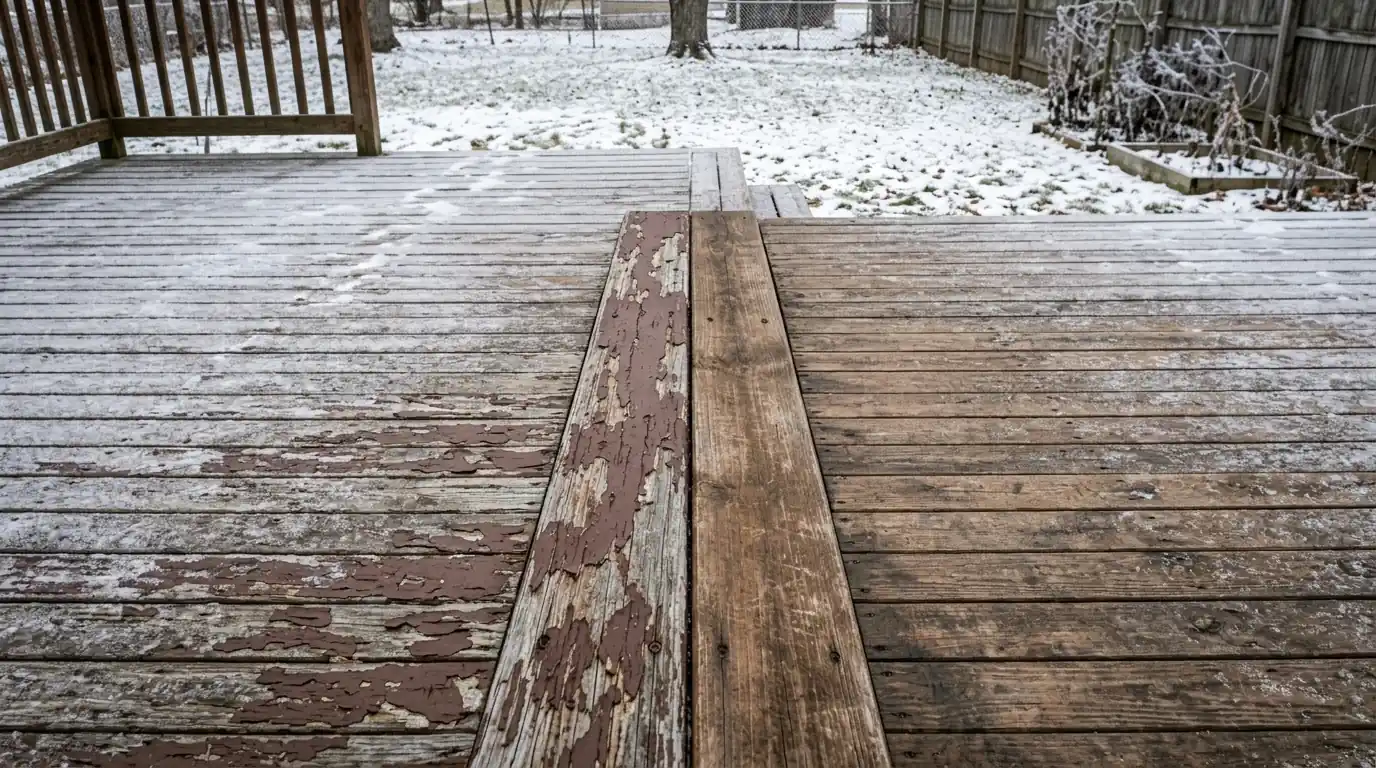
Paint forms a continuous film on top of the wood. On a deck floor, water gets under that film through cracks, board ends and fastener holes, and the wood swells and shrinks underneath it. The film cannot move with it, so it cracks and lifts, first in the path from the door to the steps.
Once paint starts peeling on a deck, the fix is sanding or stripping back to bare wood, because new paint over loose paint only peels faster. That is the main reason most deck professionals steer owners away from paint on horizontal boards.
Why stain behaves differently
Penetrating stain soaks into the wood fibers rather than sitting on top. As it wears, it fades rather than peeling, and the next coat goes on after a cleaning with no stripping. Semi-transparent stain shows the grain; solid stain hides it and behaves more like paint, which is why solid stain on a deck floor needs thin coats and good prep.
The trade-off is frequency. Stain on a sunny deck floor needs a maintenance coat every few years. Our deck staining page covers how a maintenance coat is applied.
What Indiana weather does to a deck finish
Indianapolis gets rain and snow in every month and more than a hundred freezing nights in a normal year, and the summers that follow are long, warm and humid. A deck here swings between soaked, frozen and baked, which is the worst case for a film finish and exactly where a penetrating stain holds up best.
Summer sun also matters. About a hundred days a year reach 80 degrees or warmer, and that UV breaks down finishes on the sunny side of the deck years before the shaded side. Solid stains carry the most UV protection; clear sealers carry the least.
Want someone to look at the deck and recommend a finish?
Call (317) 680-1946Where paint and solid stain do make sense
On railings, balusters, skirting and posts there is no foot traffic, and water runs off vertical surfaces, so paint and solid stain last well there. Many decks look best with a semi-transparent floor and a solid-color or painted railing.
On older decks with mismatched boards, a solid stain can unify the look better than a semi-transparent one. If the old finish is already peeling, the deck needs restoration and stripping first, whichever finish goes on next.
Porches are the exception
Covered tongue-and-groove porch floors are traditionally painted with a floor and porch enamel, and that works because the roof keeps most rain off them and the boards are tight. Open decks are a different surface. Porch work is covered on our porch painting page.
If your deck is partly covered, the covered section may take paint well while the open section is better stained. It is fine to split the finish along a board line.
How to decide for your deck
Choose semi-transparent stain for sound cedar or treated boards you want to look like wood. Choose solid stain for older, weathered or mismatched boards and for railings. Reserve paint for covered porch floors, railings and trim. If you want the lowest maintenance with a natural look, consider how much sun the deck gets: full-sun decks need recoating more often whatever you choose.
Whatever the choice, cleaning, brightening and letting the wood dry before finishing matter more than the product on the label.
FAQ
Questions this guide gets asked
You can, but paint on floor boards tends to peel. Stain usually lasts better on the walking surface.
Every few years, sooner on sunny decks and busy paths.
Similar look, but it is thinner and less prone to peeling when applied in thin coats.
Only after stripping or sanding the paint off.
Composite is cleaned rather than stained or painted in most cases.
Related
Services this guide relates to
Deck Staining & Sealing
Semi-transparent stain and more.
learn about deck staining & sealingDeck Restoration & Stripping
Chemical strip and brighten and more.
deck restoration & stripping servicePorch Painting
Porch floor paint and more.
Porch PaintingMore guides
Ready when you are
Get the deck looked at before you buy a finish
Describe the deck and its current finish, and we will book a visit on the call, any hour.
Faber Paint & Blinds service office
3053 Stillcrest Ln, Indianapolis, IN 46217