
Decks, Fences & Coatings in Indianapolis
Concrete staining and sealing in Indianapolis
A patio that has gone gray and blotchy, a driveway pitting at the edges, or steps flaking every spring. Sealing protects outdoor concrete from water and salt; staining changes its color at the same time.
- Phones answered 24/7
- Penetrating or film sealers
- Stain and seal in one job
Paint lines and window treatment brands we work with
Quick answer
Concrete staining and sealing in Indianapolis means cleaning the slab, removing old failing sealer, repairing cracks and spalls, optionally staining for color, and applying a sealer that keeps water and deicing salt out. Published market figures put sealing at $1.35 to $2.50 per square foot installed, and staining an existing patio at about $3 to $10 per square foot.
What the job involves
Why outdoor concrete needs sealing here
Updated September 2026
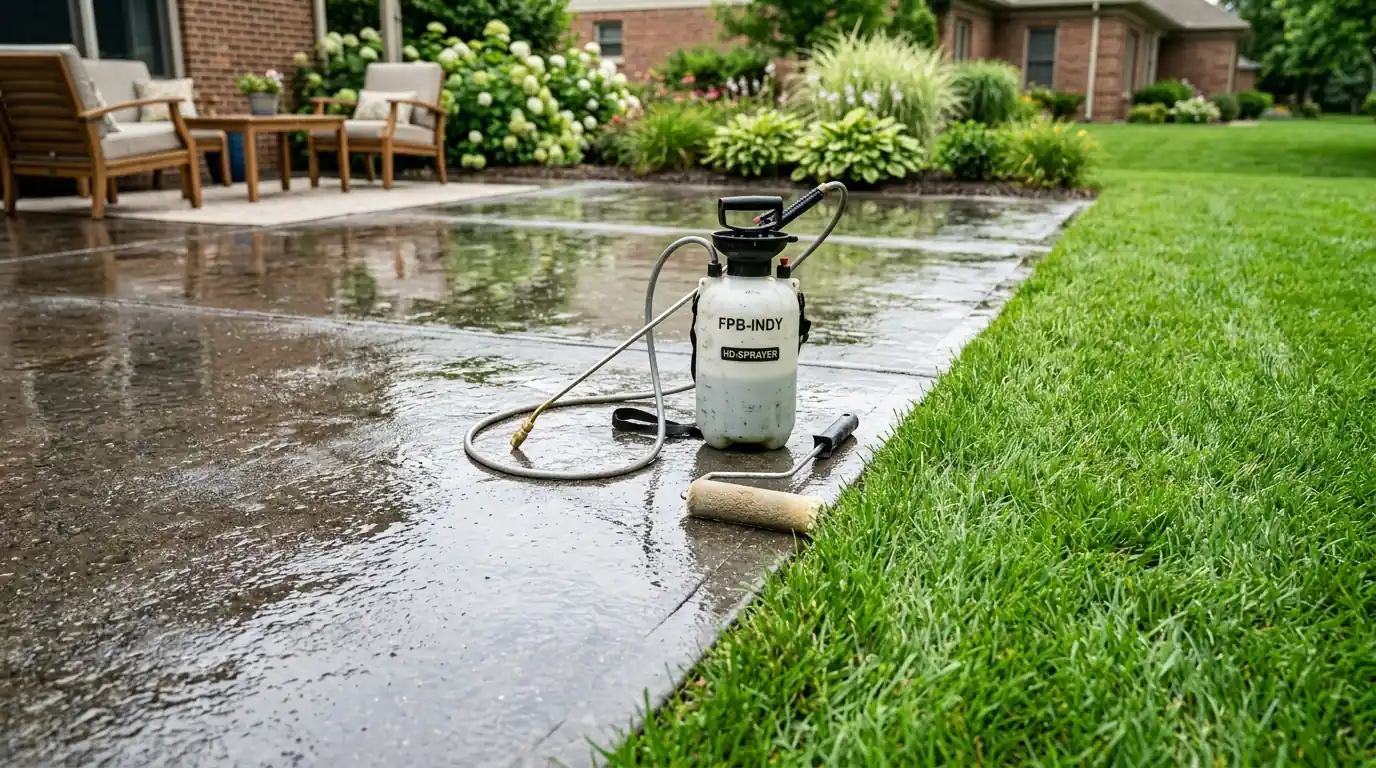
Unsealed concrete absorbs water, and when that water freezes it pops small flakes off the surface, which is the scaling and pitting you see on older walks and driveways. Deicing salt speeds that up. A sealer keeps water and salt out of the surface, and a colored stain can refresh or change the look of a patio at the same time.
We use concrete stains and sealers from Behr, Sherwin-Williams and PPG and choose between penetrating sealers, which soak in and leave a natural look, and film-forming sealers, which darken and add sheen. Garage floors take a full coating instead; see garage floor epoxy. Washing uses our surface cleaner process.
Choosing between the options
Penetrating sealer, film sealer or stain and seal
| Consider | Penetrating sealer | Film (acrylic) sealer | Stain and seal |
|---|---|---|---|
| Look | Natural, no sheen | Darker, wet look, some sheen | New color, then sealed |
| Slip resistance | Unchanged | Needs anti-slip additive | Depends on sealer |
| Best for | Driveways, steps, walks | Patios where color depth matters | Faded or blotchy patios |
| Reapplication | Longer between coats | More frequent | Reseal every few years |
Driveways and steps usually get penetrating sealers; patios are where film sealers and stain look best.
What moves the price
What moves the price of staining and sealing
Market figures put concrete sealing at $1.35 to $2.50 per square foot installed, with most homeowners spending $1,350 to $3,500, and staining an existing patio at $3 to $10 per square foot.
- Area Square footage of patio, walks, drive and steps.
- Old sealer removal Stripping failing sealer runs $1 to $3 per square foot on its own.
- Repairs Crack filling, spall patching and step resurfacing.
- Stain or seal only Staining adds color work and testing before sealing.
- Sealer type Penetrating and film sealers differ in cost and life.
- Oil and stains Degreasing and stain treatment before sealing.
- Access and cure time Driveways closed to cars during cure need planning.
Ranges are published market figures for planning only, not a quote from us; your price depends on the factors above.
Variations of this job
The concrete staining & sealing jobs we get called for
Patio and walkway sealing
Patios and walks are cleaned with a surface cleaner, stains are treated, and old flaking sealer is stripped so the new one bonds evenly. Cracks are filled with a flexible concrete sealant. Then a penetrating silane or siloxane sealer goes on for a natural look, or an acrylic film sealer for a darker, richer color with some sheen. Film sealers on walkways get a fine anti-slip additive so they are not slick when wet. Penetrating sealers typically last longer between recoats than film sealers.
Driveway sealing
Driveways take car traffic, dripped oil, and the salt that tires carry in all winter, so they usually get a penetrating sealer that will not peel or turn slippery under tires. Oil spots are degreased first, since sealer will not bond over oil. Expansion joints are cleaned out and resealed where the old filler has failed. The drive is closed to cars until the sealer has cured, typically a day or more depending on the product and weather, so we plan around your parking.
Concrete staining
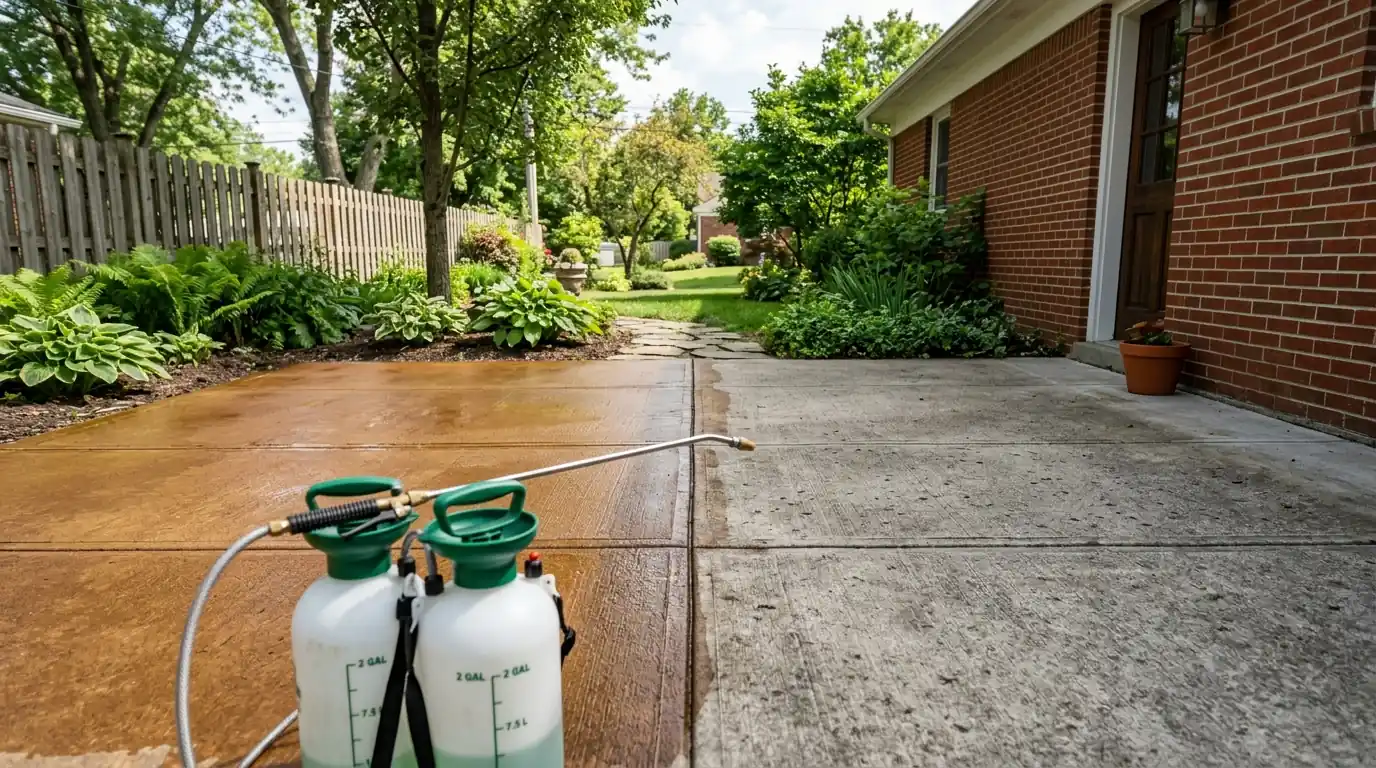
Staining changes the color of existing concrete. Acid-based stains react with the concrete for a mottled, variegated look; water-based stains give more even, predictable color and a wider palette. Either way, the slab has to be clean and free of old sealer, because stain cannot penetrate a sealed surface. We test a small hidden area first to show how your concrete takes color, then stain and seal. Stained concrete is resealed every few years to protect the color from sun and foot traffic.
Porch steps and stoops
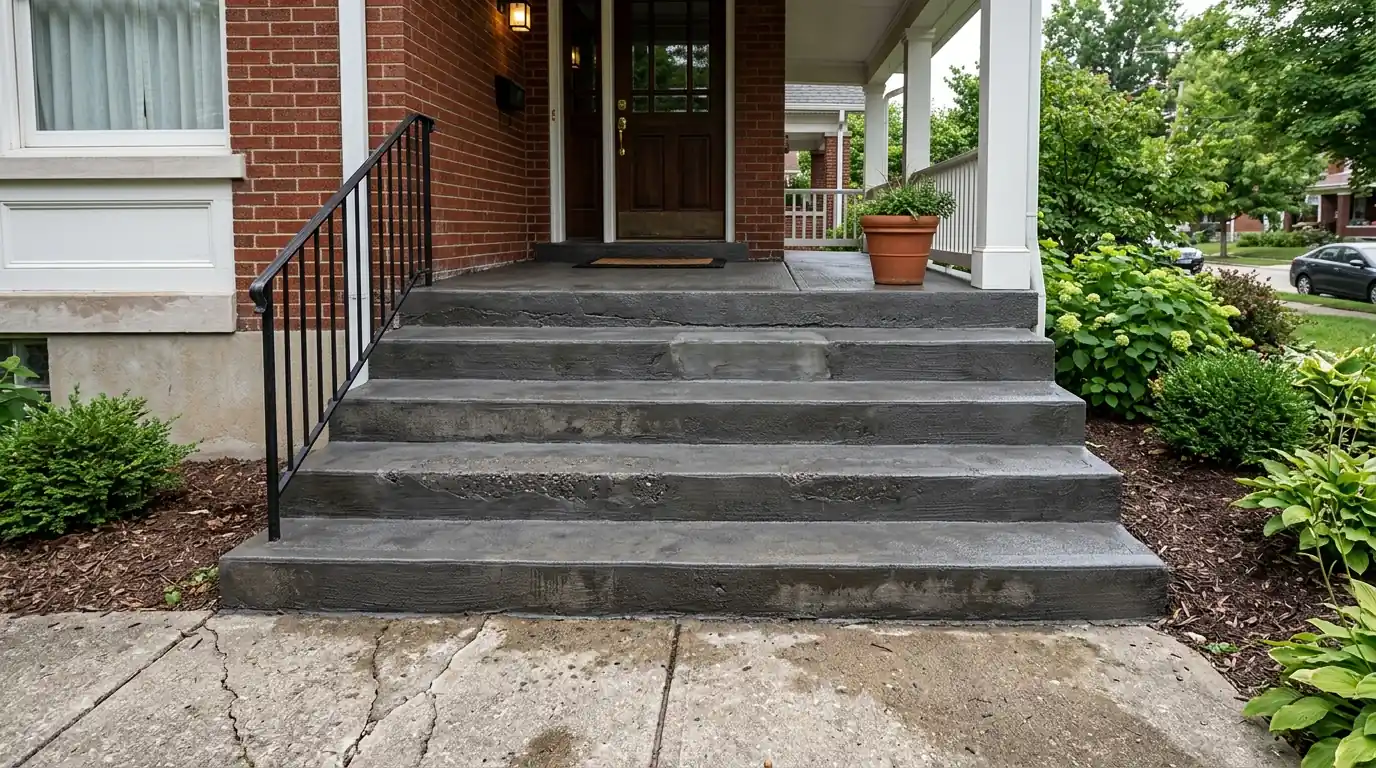
Concrete steps and stoops take the most salt of any concrete at a house, because they are where people clear ice first. Scaled and pitted treads are cleaned, loose material is removed, and spalled areas are patched with a repair mortar before sealing. A penetrating sealer is usually best on steps because it does not make the surface slippery. Where treads are badly scaled, we can resurface them with a thin polymer overlay before sealing, and we tell you when a step needs replacing instead.
Local context
How this work runs around Indianapolis
Indianapolis applies roughly 35,000 tons of salt to its roads in an average winter, and homeowners are responsible for clearing their own sidewalks, so salt ends up on walks, steps and driveways on both counts, tracked in on tires and spread by hand. That salt, combined with repeated freezing, is what scales the surface of unsealed concrete. Sealing before the first hard freeze is the simplest way to slow it down.
From your call to the final walk-through
How a concrete job runs
- 01
Call and describe the concrete
Patio, walk, drive or steps, and what it looks like now.
- 02
Visit and test
We check old sealer, scaling and cracks, and test color if staining.
- 03
Written scope
Cleaning, repairs, stain, sealer type and cure time.
- 04
Clean and strip
Surface cleaner, degreaser, old sealer removed.
- 05
Repair
Cracks filled, spalls patched, joints resealed.
- 06
Stain and seal
Color applied if chosen, then sealer in even coats.
- 07
Cure
Foot traffic and car traffic kept off until cured.
Doing it yourself vs. calling us
Sealing concrete yourself versus calling us
| Step | Doing it yourself | When we do it |
|---|---|---|
| Prep | Hose and broom | Surface cleaner, degreaser, old sealer stripped |
| Application | One thick coat | Thin, even coats that do not haze or peel |
| Repairs | Sealed over | Cracks and spalls fixed before sealing |
A small patio with a penetrating sealer is a fair DIY job. Staining, driveways with old film sealer and scaled steps are where results go wrong.
FAQ
Questions we hear on this job
Every few years for film sealers, often longer for penetrating sealers.
Film sealers can be; we add an anti-slip additive on walking surfaces.
Only if it is sound. Flaking sealer is stripped first.
It slows it significantly by keeping water and salt out of the surface.
Yes, once it is clean and free of sealer; we test a hidden area first.
Dry, mild weather before the first hard freeze.
Related services
Other decks, fences & coatings work we handle
Fence Staining & Painting
Cedar privacy fence, sprayed stain on long runs and more.
learn about fence staining & paintingDeck Staining & Sealing
Semi-transparent stain, railings and balusters and more.
Deck Staining & Sealing in IndianapolisDeck Restoration & Stripping
Chemical strip and brighten, sanding and re-coat and more.
Deck Restoration & Stripping in IndianapolisGarage Floor Epoxy
Full-flake epoxy, basement floor coating and more.
Garage Floor EpoxyReady when you are
Describe the concrete and we will set the visit
Tell us which slabs and what they look like, and we will book the visit on the call, any hour.
Faber Paint & Blinds service office
3053 Stillcrest Ln, Indianapolis, IN 46217