
Decks, Fences & Coatings in Indianapolis
Garage floor epoxy coating in Indianapolis
An oil-stained garage slab, a basement floor that sheds dust, or a coating from a kit that peeled under hot tires. Floor coatings last when the slab is ground open, not just washed.
- Phones answered 24/7
- Slab ground, not just etched
- Moisture tested first
Paint lines and window treatment brands we work with
Quick answer
Garage floor epoxy in Indianapolis starts with a moisture test and diamond grinding to open the concrete, then crack and spall repair, a base coat, optional color flake broadcast to refusal, and a clear topcoat. Hot-tire pickup and peeling come from poor surface prep, which is why grinding matters more than the coating itself.
What the job involves
Why kit coatings peel and ground floors do not
Updated September 2026
Concrete has a smooth, weak top layer and often oil or sealer soaked into it. A coating rolled over a washed slab bonds to that layer, and hot tires pull it up. We diamond-grind the slab to open its pores, vacuum the dust, test for moisture coming up through the slab, and only then apply a two-part epoxy base and topcoat from coating lines by Sherwin-Williams, Behr or PPG.
Basement floors that only need a lighter coating are covered on our basement painting page. Walls and doors in the garage follow our garage door and interior processes.
What is included
What a garage floor coating includes
- Moisture test on the slab before choosing the system
- Diamond grinding with dust extraction, not acid etching
- Cracks and spalls cut out and filled
- Oil-soaked areas degreased and ground clean
- Epoxy base coat at full coverage
- Flake broadcast to refusal and scraped, where chosen
- Clear topcoat with anti-slip where needed
Choosing between the options
Full flake, solid color or polyaspartic topcoat
| Consider | Full-flake epoxy | Solid color epoxy | Polyaspartic topcoat |
|---|---|---|---|
| Look | Textured, speckled | Uniform color | Clear, high gloss over either |
| Hides dirt | Best | Least | Depends on base |
| UV and yellowing | Epoxy topcoat can amber in sun | Same | Resists yellowing |
| Cure before cars | Several days | Several days | Shorter |
Full flake with a polyaspartic topcoat is the most requested combination for garages that open to the sun.
What moves the price
What moves the price of a floor coating
No sourced figure is quoted here; floors are priced by area, slab condition and system.
- Floor area One-, two- and three-car garages scale the material and grinding time.
- Slab condition Cracks, spalls and old coatings add grinding and repair.
- Moisture High vapor needs a moisture-mitigating primer.
- System Full flake, solid color and polyaspartic topcoats differ in material and steps.
- Oil and sealers Contaminated areas need degreasing and extra grinding.
- Stem walls and steps Coating up the curb and steps adds detail work.
- Temperature Cold-weather jobs may need a heated space to cure.
Variations of this job
The garage floor epoxy jobs we get called for
Full-flake epoxy
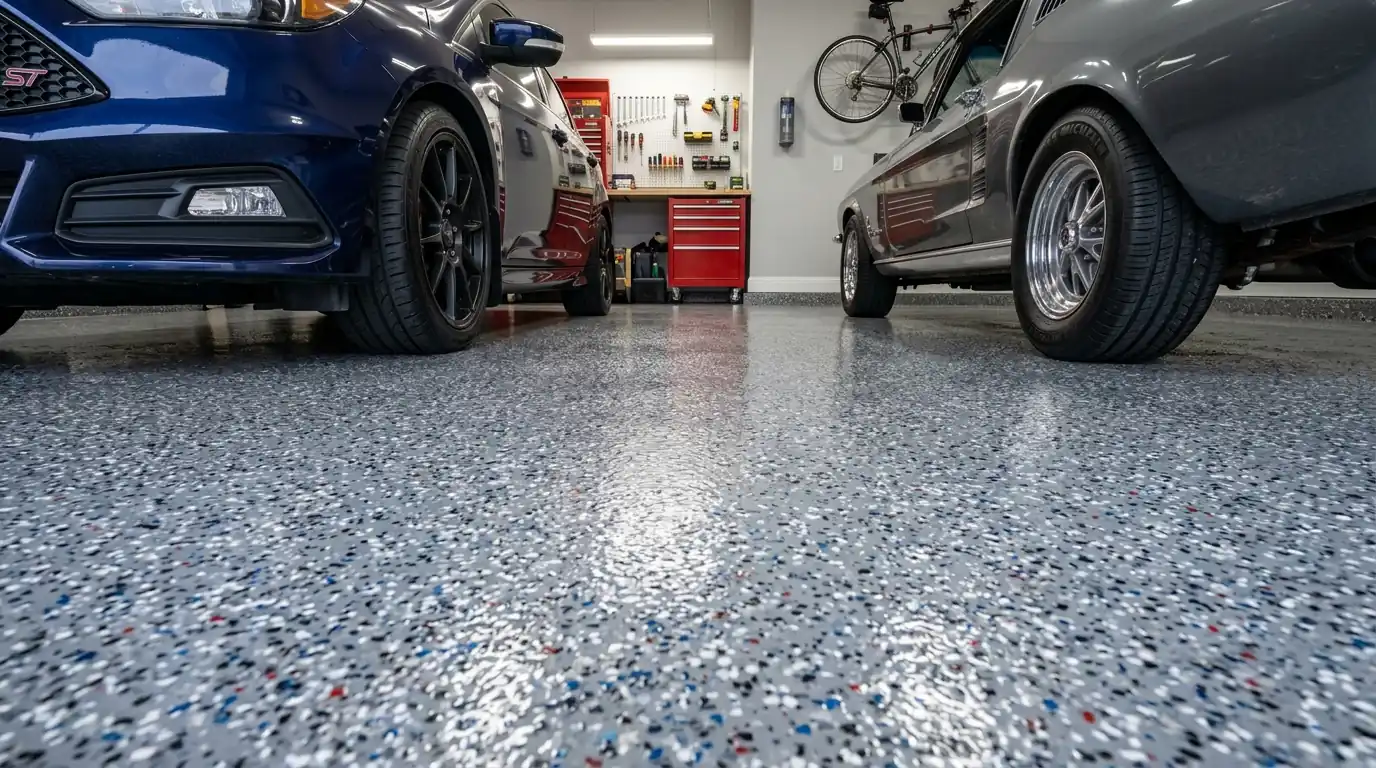
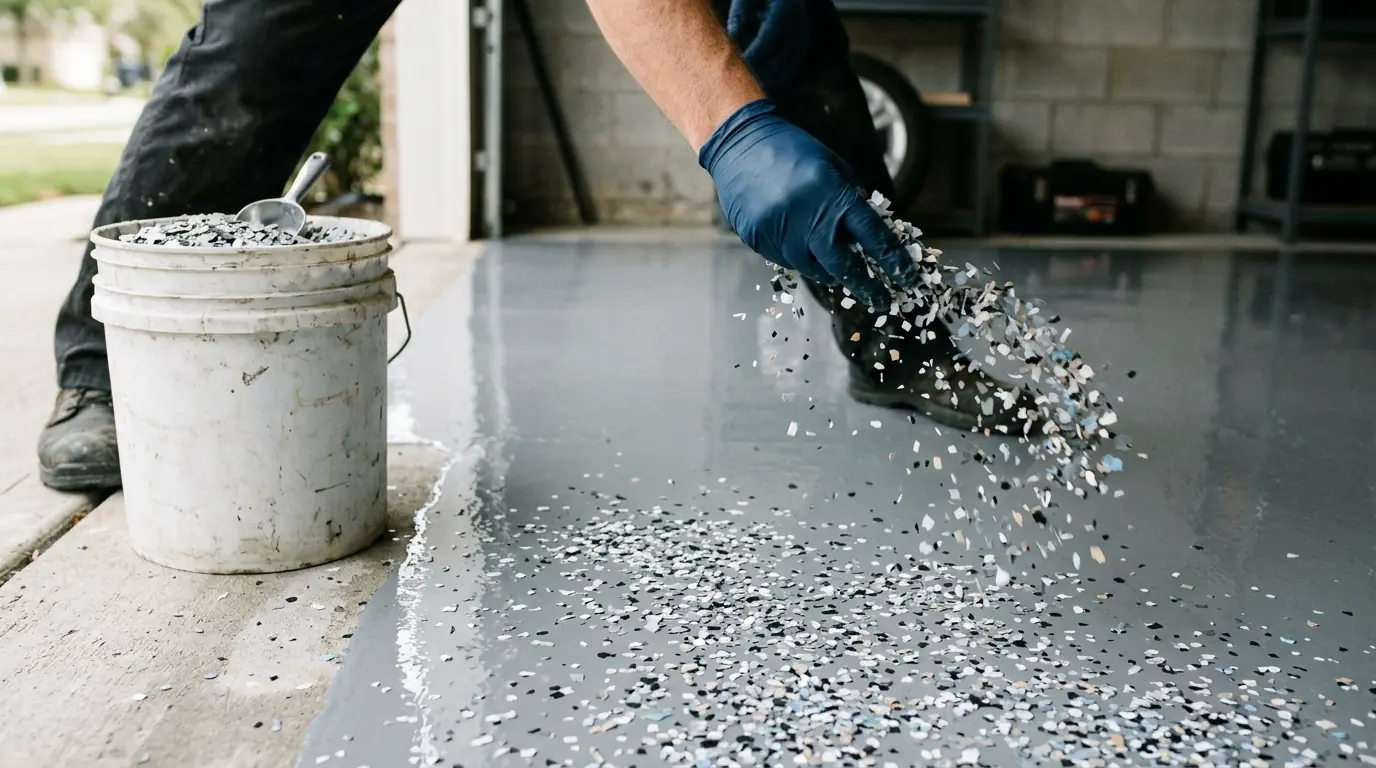
Full flake is the most popular garage floor: after the base coat goes down, vinyl color flakes are broadcast by hand until no base coat shows, the excess is scraped and vacuumed off, and a clear topcoat locks it in. The flake hides dirt, tire marks and slab imperfections, and the texture it leaves gives some grip underfoot. It is the most forgiving finish for a working garage. Color blends range from grays and tans to darker mixes that hide oil and road grime.
Solid color epoxy
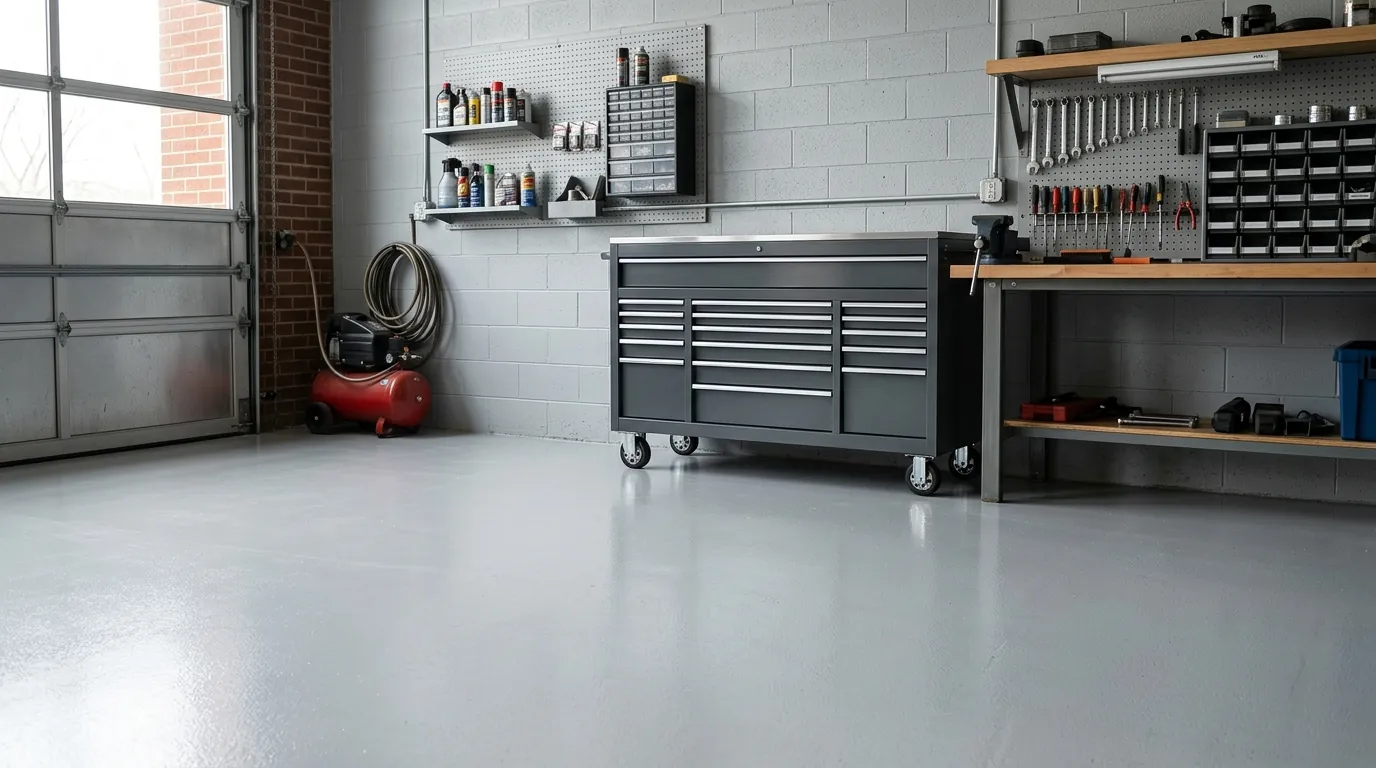
A solid color floor is a pigmented epoxy base and topcoat without flake. It gives a clean, uniform look popular in workshops and basements, and it is easy to sweep. Because it shows every tire mark and dust mote, many owners add a light flake scatter instead of full coverage. An anti-slip aggregate is mixed into the topcoat so the floor is not slick when wet, which matters in a garage where snow and ice melt off the car all winter long.
Concrete grinding and crack fill
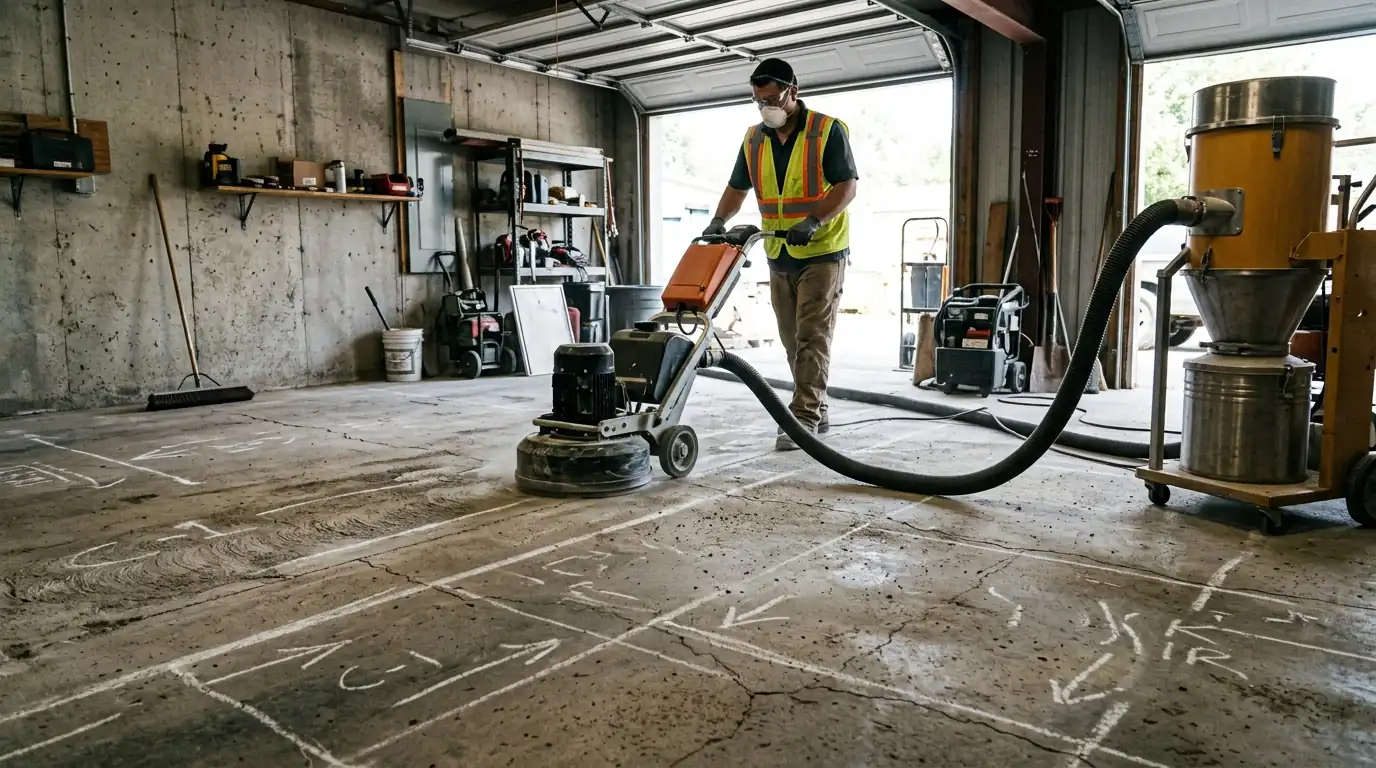
Grinding is the step that decides whether a coating lasts. We use a diamond grinder with dust extraction to remove the weak surface layer, old sealers and paint, and to open the concrete so the epoxy can bite. Cracks are cut out and filled with a rigid or semi-rigid filler, spalled and pitted areas are patched and ground flush, and control joints are either filled or honored depending on your preference. Oil-soaked areas are degreased and ground again until clean, sound concrete shows.
Basement floor coating
Basement slabs are coated for a cleaner, brighter floor and to stop concrete dust. They often carry more moisture than garage slabs because they sit below grade, so the moisture test decides the system: a standard epoxy on a dry slab, or a moisture-mitigating primer under the coating where vapor is higher. We keep the coating off floor drains and sump pits, and the floor is coated in sections if a basement cannot be emptied all at once, one half cured before the other.
Local context
How this work runs around Indianapolis
North Irvington Gardens alone counts more than 550 historic garages alongside its houses, and across Indianapolis many older detached garages have slabs that were poured thin and have settled and cracked over the decades. Winters here are short but very cold and snowy, so snowmelt sits on those slabs for months, and an epoxy has to be applied in the warm months or in a heated garage where the slab can reach the product's temperature.
From your call to the final walk-through
How a floor coating job runs
- 01
Call and describe the floor
Garage size, current coating and any cracks or stains.
- 02
Visit and moisture test
We test the slab and look at cracks and old coatings.
- 03
Written scope
System, colors, repairs and cure time.
- 04
Empty and grind
Garage cleared, slab diamond-ground with dust extraction.
- 05
Repair
Cracks and spalls filled, oil spots cleaned.
- 06
Coat
Base coat, flake broadcast if chosen, clear topcoat.
- 07
Cure
Foot traffic first, then vehicles after the full cure.
FAQ
Questions we hear on this job
Usually because the slab was washed or etched rather than ground, so the coating never bonded.
Several days for epoxy; a polyaspartic topcoat can shorten that.
Flake adds texture, and an anti-slip additive goes in the topcoat.
Only after grinding it off or roughening it to sound material.
In a heated garage where the slab reaches the product's temperature.
Yes, after a moisture test that decides the primer.
Related services
Other decks, fences & coatings work we handle
Concrete Staining & Sealing
Patio and walkway sealing, porch steps and stoops and more.
learn about concrete staining & sealingFence Staining & Painting
Cedar privacy fence, sprayed stain on long runs and more.
learn about fence staining & paintingDeck Staining & Sealing
Semi-transparent stain, railings and balusters and more.
Deck Staining & Sealing in IndianapolisDeck Restoration & Stripping
Chemical strip and brighten, sanding and re-coat and more.
Deck Restoration & Stripping in IndianapolisReady when you are
Tell us the garage size and we will set the visit
Describe the floor and what is on it now, and we will book the moisture test and quote visit on the call, any hour.
Faber Paint & Blinds service office
3053 Stillcrest Ln, Indianapolis, IN 46217